Showing posts with label guidance. Show all posts

Sunday, February 12, 2017

Green Spaces May Deter Crime, Urban Studies Reveal

BuildingGreen
https://www.buildinggreen.com/newsbrief/green-spaces-may-deter-crime-urban-studies-reveal

Saturday, February 11, 2017

Why drawing needs to be a curriculum essential

Why drawing needs to be a curriculum essential | Culture professionals network | The Guardian https://www.theguardian.com/culture-professionals-network/culture-professionals-blog/2014/may/29/drawing-needs-to-be-curriculum-essential-education?CMP=share_btn_fb

Saturday, February 4, 2017

Ground up Urbanism Texts

Hackable Cities: A Toolkit for Re-Imagining Your Neighborhood, by Cecilia Tham's Studio of Strategic Design + Management Program, Parsons The New School for Design. (c) 2014. Available on ISSUU,http://issuu.com/pgildner/docs/hackable-cities-pages/1

Tactical Urbanism Vol 1, Street Plans Collaborative. ISSUU,http://issuu.com/streetplanscollaborative/docs/tactical_urbanism_vol.1/1

Tactical Urbanism Vol 2, Street Plans Collaborative. ISSUU,http://issuu.com/streetplanscollaborative/docs/tactical_urbanism_vol_2_final/1

Bottom-Up Urbanism: A Survey of Temporary Use in Europe, David Glick. ISSUU,  http://issuu.com/davidglick/docs/bottom-up_urbanism/1

Public Interest Design: Evaluating Public Architecture. A collaborative report by the University of Texas School of Architecture Center for Sustainable Development, its Public Interest Design Externship Program, and Public Architecture. ISSUU.http://issuu.com/publicarchitecture/docs/pid_externship_report_2012-13_final/1

Parklets- Experiments in Urban Public Space. Research Report from 2012 Public Interest Design Summer Program's Externship with Public Architecture. ISSUU. http://issuu.com/giladmeron/docs/parklets_issuu/1

Handmade Urbanism. Planum the Journal of Urbanism. ISSUU.http://issuu.com/planumnet/docs/handmade_urbanism_total_pdf/1

Kickstart Urbanism, starting planning projects is difficult but can be helped by kickstart urbanism. Markus Appenzeller MLA+, ISSUU.http://issuu.com/mlaplus/docs/kickstart_urbanism/1

Atlantis #23.2 Re-thinking Practice. TU Delft. 11/2012.ISSUU.http://issuu.com/atlantismagazine/docs/atlantis__23.2_re-thinking_practice/1

In Favour Of Public Space. First of European Prize for Urban Public Space. Actar Publishers. ISSUU. http://issuu.com/actar/docs/publicspace/1

British Pavilion Curators Interview: Crimson Architectural Historians. The Architectural Review: (2014) http://youtu.be/pbtN3xAsFE8

Friday, February 3, 2017

What If Bike Paths Looked Like Subway Maps?

How to Get More People to Bike: Better Maps - CityLab http://www.citylab.com/commute/2017/02/what-if-bike-maps-looked-like-subway-maps/512657/?utm_source=nl__link3_020317

Thursday, February 2, 2017

YAF 2017 Kickoff Social

YAF Social Flyer 02-02-17.jpg

YAF will be hosting the 2017 Kickoff Social on Thursday February 16th, 2017. We hope to see all AIA Members, Assoc. AIA, Young Architects and Local Students present. We will be introducing our committee members and putting a face to each of the items we will be covering this year, this will provide a direct contact for the Young Architects and Students in our Chapter to answer any of your questions. Please come out and Join us.

ATTEND! We will have some important announcements and raffle a book.

This event is free of charge, everyone is responsible for anything you consume at the bar. We will be raffling an architecture book so please bring your business cards to drop into the drawing bowl.

See you all there,
sign up to this event here:

Monday, January 30, 2017

Half-cruise, half-cargo ships for travel

http://www.latimes.com/travel/la-tr-freighter-20170129-story.html

Saturday, January 28, 2017

Fabricators, subcontractors and suppliers

Along the way we will need expertise, especially if we plan to do anything out of the ordinary. Even if what we plan is not that crazy it may still require skills that we do not have.

There is a task on the schedule, under P3, concerning "early subcontractor participation requests". These can begin now. Come to me (email me) with ideas, needs and possible connections you may have.

Precedent. The word, the concept, your world...

Help!
There are still misspellings (wrong word used!) on the blog. Precedent is one of them. Please, please go look up the word precedent. Understand it. Learn to spell it. Learn it's plural form and other forms. Use it well, with confidence. Please. Edit your posts accordingly. Thank you.

While a precedent may take precedence, the plural of precedent is not precedence! It is precedents.

Thursday, January 26, 2017

Template Product/Service Request Letter

This can be used to introduce the project and goals to prospective supporters. You will include language that briefly expresses your interest and intention for the material or other support. Let me know if you have any questions.

Shipping Container Design/build Course at UF CityLab-Orlando
School of Architecture - University of Florida College of Design Construction and Planning
at the Center for Emerging Media
500 West Livingston Street
Orlando, Florida

Course Number: ARC6355
Course Title: Advanced Studio II
Term: Spring 2017 (January through May)
Professor: Stephen Bender, Adjunct Assistant Professor, UF Professor in Residence
email: sbender@ufl.edu
phone: 352.682.4986 (always prefer e-mail)

Project Goals
In a sentence, the goal of this design studio is to give students the opportunity to be socially engaged in their community, while learning first-hand about an innovative and sustainable construction unit, the upcycled shipping container, in the context of their pursuit of professional degree credit.

The design will be undertaken under the guidance of Stephen Bender, a Florida licensed architect specializing in shipping container architecture and Adjunct Assistant Professor. The construction will be undertaken primarily by the students under his guidance with assistance and support of local contractors and suppliers. We have a location to do the construction nearby to our facility. We seek ways to impact communities using shipping containers. These projects will set the stage for later, larger developments by introducing people to containers up close in the context of their everyday lives. This first project intends to offer assistance to the community that Citylab resides in, neighborhoods in downtown Orlando.

This project will transform shipping containers into individually focused mobile design/action centers. One will be focused on Food and Farming in the City, Urban Horticulture. One will be focused on Street Life in the City, Intermodal Urbanism. With our limited time and funds, these first two are our top priority. A third, possibly later conversion, will be focused on Water and the City, Hydro-generated Urbanism.

The projects will be completed in late April. At this time the containers will be positioned in Orlando neighborhoods and put to use. The Urban Horticulture container may have its first home as part of a community gardening project in downtown Orlando. The Intermodal Urbanism container may have its first home as part of a bicycle/pedestrian trail system in downtown Orlando. (*Locations may change as necessary but the community focused impact will remain.) The portability of the units means that their impact will be multiplied through be locations in future areas of need.

We seek your support.

Sunday, January 22, 2017

Envelope Assembly Mock-up Example GFRC SIP

This is an example of some of the process of the mock up project....

I am interested to make an SIP panel with the container wall panel as the one side and thin precast concrete cladding as the other. I predict that using GFRC will be the best way to get a thin but strong and durable cladding. My system must define the material and process of the cladding and the insulating core. It must also define the way the system becomes an structurally integrated panel.

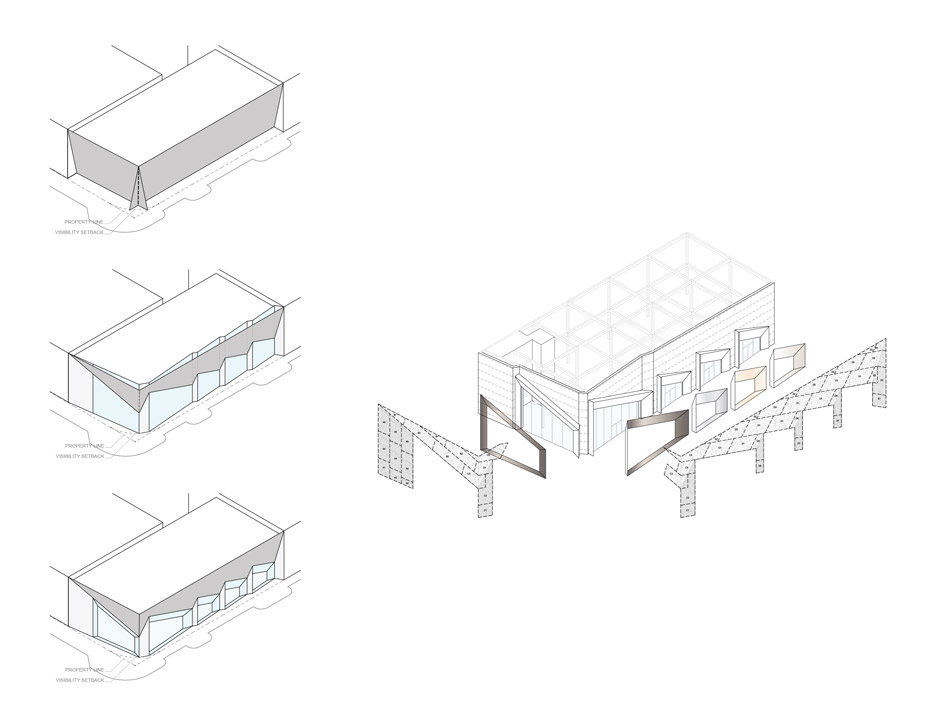
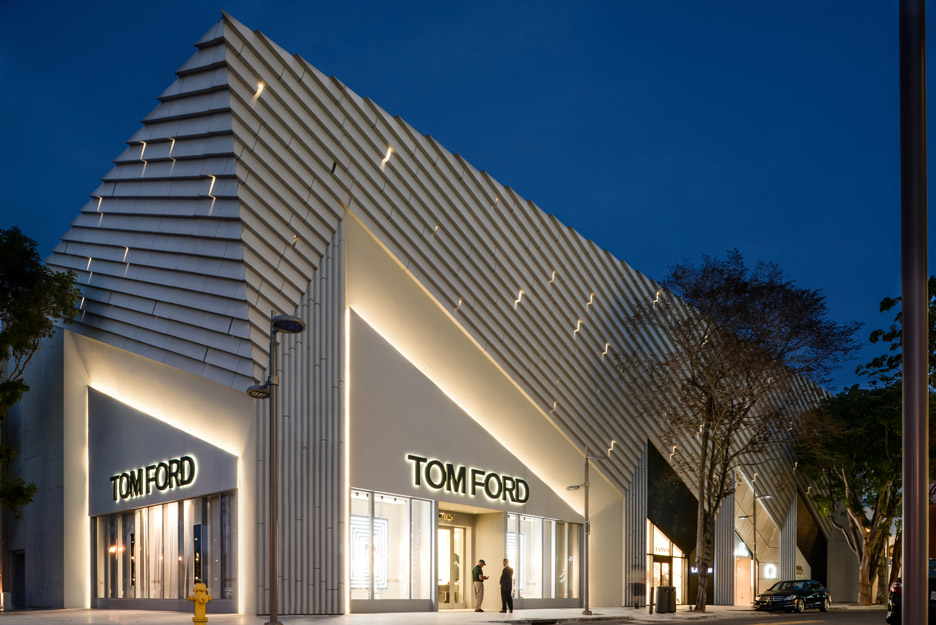
<Insert precedent images and sketch here. Probably Zaha project or Aranda\Lasch Tom Ford store, but also low-tech precast like insulated tilt-up wall. This shows the range of technology in use.>

High Tech Precedent (not-insulated)
Source. ArandaLasch adds pleated concrete facade to Tom Ford store.


Facade diagram and image (Dezeen)

Low(er) tech precedent (insulated)


Some background on architects use of concrete, specifically precast and more specifically GFRC.
Architect's Profile: Zaha Hadid, Concrete Virtuoso.
"Hadid used GFRC in a variety of projects around the world. These include the Capital Hill residence in Moscow, Russia, built in 2008, which has been likened to a spaceship due to its undulating shape and twin towers jutting upward. The project earned “Best Project” at the 16th World GRC Congress. “During the design phase, the architectural team was contemplating natural stone, GFRC, and GFRP [glass-fiberreinforced polymer] for the façade,” says the GFRC provider, Fibrobeton in Istanbul, Turkey. “After seeing the first mock-up, the architect decided the best alternative to put the project into practice was GFRC. This technology made extremely significant contributions to both the designer and the main contractor.”

100 Museum.
Rendering: © 2014 Paul Morris

"The 1000 Museum condominium project in Miami, Fla., currently under
construction, features an exoskeleton of GFRC panels being shipped from Dubai
by a PCI-certified precaster. The design provides a rigid exterior frame that will
be functional and decorative." - PCI article.

GFRC research and information.
GFRC Suppliers.
http://www.zohostone.com/projects.php

GFRC Industry information.
FAQ | GFRC
http://gfrccladding.com/faq/#

Code related information.
Miami-Dade NOA.
http://gfrccladding.com/pdf/MiamiDadeNOA2012-02.pdf

DIY, how-to information.
Casting Thin Concrete Furniture with GFRC
http://www.concretedecor.net/decorativeconcretearticles/vol-13-no-7-october-2013/casting-thin-concrete-furniture-with-gfrc/

http://makezine.com/2012/04/11/how-to-mix-and-mold-gfrc/

Possible hands on training!
GFRC Training with Mark Celebuski February 23 – 24
http://www.lrgsolutions.com/product/gfrc-training-with-mark-celebuski-february-23-24/?gclid=CjwKEAiAtefDBRDTnbDnvM735xISJABlvGOvHSqtFFTLq_k_wv0ffex9TnD46BfXJDyLsvsrKxQt5hoCoFXw_wcB

What about the insulation core of the SIP system I propose?
Insulation materials.
Cellular Light Weight Concrete.
http://www.foam-concrete.com/

Plastic foams.
Allied Foam Tech Corporation
http://www.alliedfoamtech.com/Appconc.htm

Alternative sources for materials.
Biological Concrete Paving The Way For Sustainability
http://www.burnsmcdblog.com/2013/05/30/biological-concrete-paving-the-way-for-sustainability/

Now I would have to draw this idea of mine, list materials, tools and processes (step by step) for my detail project. Since I am not in studio, I don't have time for this at the moment... but I want to do this badly!

Thursday, January 5, 2017

Re: Grad 2 intro notes

Tomorrow I would like to meet with each group and discuss the direction, idea and information you have gathered so far. This will be like an informal mini presentation. Have an outline with bullet points that you will address. These can be informational or inquisitive. Thanks!

On Wed, Jan 4, 2017, 10:18 AM stephen bender <sdbender@gmail.com> wrote:
Shipping Container Studio

Field trips. 
  • Port. Shipping company yard. Likely Jacksonville. 
  • Depot. Container storage, sale, repair and modification facility. Likely Jacksonville.
  • Fabricator. Structural steel fabrication facility. Orlando. 
  • More...

Group Topics. 
  1. History/Industry
  2. Material/Energy 
  3. Specification/Construction
  4. Adaptability/Prefabrication

Divide topics into subtopics for each group member. However, presentation and publication must be unified and comment must be introduced and concluded by the group. 
Group work will be judged according to both group and individual effort. There will be submissions for each.
Individual research. 
  • Material/Assembly
  • Precedent/prototype
  • more

BIM this semester or summer.


Blog

Wednesday, January 4, 2017


Welcome to your studio blog. 
I teach using the self-publishing technology known as blogging in my design studio. I began using a blog as a teaching tool in fall 2009 and I have continued with every subsequent studio. Blogs create a reflective learning environment, a history of project process and an electronic studio community allowing students and professors to extend teaching and learning beyond the moment and beyond the studio. The blog activity creates a informative structure (a catalog of sorts) within which I reflect on my assignments and outcomes. This is at a basic level a study of the relationship between the message originator and the message receiver. It is a reflection on the way I teach and how students learn.

Blog Posting Rules
Other professors along with your studio peers will be looking at your posts so you want to be sure that:

  • Posts are free from silly SPELLING and GRAMMAR issues (please check)
  • Posts contains STRONG STATEMENTS concerning your thoughts and direction (please revise)
  • Posts are properly LABELED (label names will be discussed)
  • Posts contain the BEST and latest version of your work (please revise)
  • Posts may contain PROCESS work and key images as well (however, use the "process" label)
  • The "guidance" and “assignments” labels belong to your's truly (me).
As mentioned above, you have be sure to LABEL your post so that it is possible to sort. This is very important to the way the blog functions. The "Labels" input field is found at the right of the editing area. Use a limited number of labels (but you may be creative). Before you do anything else label the post with your name. Name label format shall be "first name". Use title case to enter blog titles and labels. Next add a label using the subject from the assignment email. For example, “P1 X2 Sketch”. You will notice that when a label has been added, it shows up when you enter the first few letters.
At the end of a project I will create a "page" of links that will use labels to sort the blog. You will need to do some housekeeping with your labels to make sure they show up where they should. Label only the best or final version of your work as it falls under a heading. All others can be labeled "process". You can still use multiple labels, so a viewer can click on a label very specific to your work.

Images
Because we make large hi-res image files, it may be difficult to post to the blog with your final image, even after it is flattened. Here is a piece of freeware that I use to resize images quickly.

If you are using the Windows version,be sure to pan down to the bottom of the page and find the"XnView vX.XX.X Complete version". It comes with the "shell extensions" which allow you to right click on your flattened jpg or png file and convert it to a number of predefined sizes. Experiment with which one does the best job for your postings.