Showing posts with label Details. Show all posts

Sunday, January 29, 2017

Details

Detail 1

Precedent : Toyo Ito's Tower of Winds
-Material selection has properties that contradict usage
-Steel is a strong/homogeneous/rigid material
-Used for a light/fluid/porous membrane


DETAIL 1


Detail 2

Precedent : Kengo Kuma's Beijing Tea House
-Modular wall system
-System has structural integrity
-INTERIOR/EXTERIOR use
-Translucent material allows for transparency between spaces/openness
Material: HDPE Plastic


Detail 3

Precedent: Penda Art Storage Hong Kong
-Caster wall system on track
-Mobile wall system 
-Reconfiguration of space
-Transformation of unit (internally)
-Repeating the corrugated language of the roof and side panels
     -Makes for pre-fabricated track for interior wall system


Additional Details

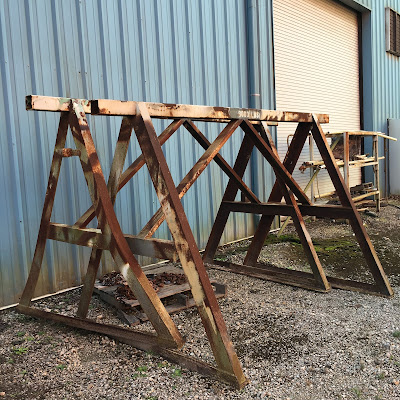
Heavy Duty Steel Sawhorse converted into community bike rack - REUSE


Exterior cable railing for recessed interior space - Exposure to the outside


Monday, January 23, 2017

Precedent Details


ETFE panels are mounted to a steel frame around each panel. the frame then has special brackets mounted to them that the panels attach to. These panels are then inflated to give a cushioned look that offers additional insulation to the building.


The copper strips are mounted onto furring channels that have additional triangular brackets mounted to them to define the angle of the strip. The strips can be mounted to the brackets by nails, interlocking folds, or even additional angle brackets. In the Signal box precedent, the triangular brackets have additional metal that is bent to create a sort of shelf that is welded directly to the back of the strip.


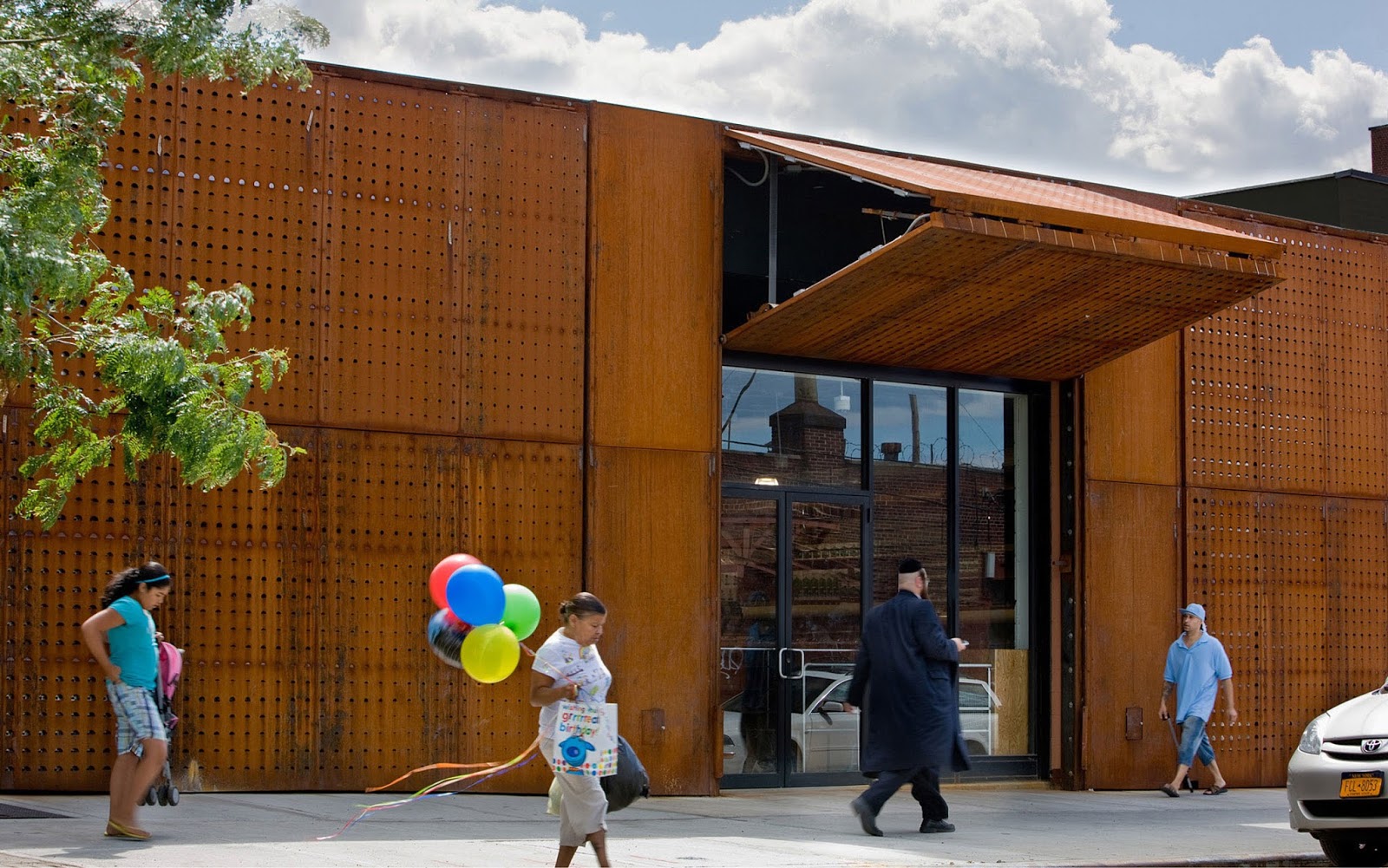
The screen panels offer a simple solution. A basic metal frame supports perforated panels that are connected via brackets. Each bay of the larger frame contained 6 or 9 panels. These panels are then connected to each other with additional brackets or directly with bolts depending on how the panels themselves are made.

Envelope Detail Mock-up

ENVELOPE ASSEMBLY MOCK-UP


Hinged Screen Wall System

 
This system of hinged perforated metal panel walls would be an interesting element to incorporate into a shipping container. I like the versatility of having the screen walls closed at night to let light permeate through and open during the day for a shading element.
 
Manufacturers: McNichols, Perftubes, CBS sheet metal
 
Materials:
Perforated Metal Panels
(Possibly fabricated from CNC)
1" Steel tubing for frame
Steel plates for top and bottom hinges
Stainless self-tapping screws
Machine Bolts/nuts/washers (zinc coated)
 
Tools:
Drill and drill bits
Angle grinder/cutting blades
Welder?


Mechanical Shading Device
 
A mechanical hand operated shading device would be a useful element to incorporate into the shipping container project. One of the reasons an adjustable feature would work well is because the final site is unknown. This would aloe the shade device to be adjusted to the best angle for the location.
 
Manufacturers: Levolux, Ruskin, Metl-Span, Ameto, Tubelight, Hansen 
 
Materials:
3/8" zinc coated threaded rod, nuts, and washers
self-tapping stainless screws
Machine bolts, nuts, and washers (zinc coated)
Stainless hinges
 
Tools:
Electric Drill and drill bits
9/16" open end wrenches
Angle grinder
File
Sand paper
Sander


Plant Pockets
 
Planting pockets fabricated into the corrugated wall of the container would be a great way to give the wall a unique look while also providing a level of natural insulation. The pockets could be created using wood slats and clay pots could be formed to fit into the pockets. This would make the pots removable and replaceable as needed. Another great aspect of this idea is that students could be give a mold to form the clay pots and add their own artistic elements before the pots are fired in a kiln.
 
Manufacturers: GSky (Versa Wall System), TWP
 
Materials:
Stainless steel mesh
Wood slats (cedar or cypress)
Clay for pots
Foam mold
Self-tapping stainless screws
 
Tools:
Electric drill and drill bits
Impact driver
Skill saw


Sunday, January 22, 2017

Task 1&2: Information and Mock Up

TASK 1: INFORMATION

Materials Need List
01/20/2017

For Algae Façade

- Water
- Algae
- Glass Panels
- Steel Metal Frame
- Tubing for Algae Nutrients
- Bracket with Thermal Breaks
- Algae Nutrients


For Glass Circle Façade

- Thick glass circle panel with hollow center
- Circular Metal Frame
- Steel Tube


For Pallet Façade

- Corrugated Metal Sheets
- Hinges

Manufacturers
01/20/2017

Need:
-Glass Manufacture
-Hollow Metal Frame Manufacture
-Steel Manufacture

Steel
1. Alro Metals Outlet (called, can pick up material for 1-5$)
a. 1101 Oak Lane, Winter Springs FL 32708
b. (407) 678-2576

Algae
1. https://www.buyalgae.com/product-category/algae/
2. http://www.carolina.com/algae/green-algae-ac-living/FAM_151955.pr?question=

Algae Food
1. http://www.carolina.com/living-organisms/protists/algae/10635.ct?N=2666129721&Nf=pro
duct.startDate%7CLTEQ+1.4848704E12%7C%7Cproduct.cbsLowPrice%7CGT+0.0&Nr=
&nore=y

Glass
1. Keating Glass Corporation (emailed so far)
a. 1717 S. Division Ave, Orlando, FL 32805
b. 407-425-5913

Detail Examples

Hallow metal frame with glazing detail


Step by Step Instructions

This video shows a guy creating a fish tank out of glass panels and silicone. Dry time takes 3 days
https://www.youtube.com/watch?v=ui-r2oTfTog

This shows how to weld metal steel tubing into frames
https://www.youtube.com/watch?v=h8aMW3l4Wj0

DIY alage to biofuel
https://www.youtube.com/watch?v=YuuDPsoRaNM


---Needs for successful cultivation
https://www.youtube.com/watch?v=jTImYag6h_k

-Appropriate light saturation point (varies based on algae type)
-Optimal temperature level (more important when cultivation is outdoors
-All cells must receive the same average light exposure
-More CO2 than is what found in the atmosphere must be added to the culture (they also need nitrous, silicone, and phosphorous)

 Quantum fracturing

And


Transesterification process
(fatty acid mixed with alcohol, catalyzed with a hydroxide to create sodium ethanoate which transforms into glycerol and 3 methyl esters (aka biofuel))


TASK 2: MOCK UP

1. Scale

The main concern with choosing a scale for the algae façade is determining the depth between the glass panels that is acceptable for algae growth. The panels from the precedence appear to be between 1”-1.5” max. Since this is such a small dimension to begin with, I would propose rather than changing the scale, just create (at full scale) a small portion of the full panel. About 10” by 12”

2. Method

            1. Collect materials
            2. Cut glass panels to correct size
            3. Attach glass panels to the metal frame
            4. Weld or bolt metal frames together
            5. Fill with water and algae

3. Drawings


4. Materials

1.Glass Panels
2. Metal Frame
3. Sealant
4. Spacer
5. Hollow Pipe
6. Tubing for nutrients
7. Welding Materials
8. Water
9. Algae
10. Algae Food
11. Air pump


5. Tools

            1. Welding equipment
            2. Tape
            3. Glass cutter
            4. Metal cutter


6. Precedents


By: Splitterwerk Architects and engineering firm Arup
Location: Hamburg, Germany
Description: “dubbed the BIQ, has a "bio-adaptive" facade that is claimed to be a first for using algae within its glass-paneled facades in order to generate energy, and provide shade, to a working building”

http://newatlas.com/algae-powered-building/27118/